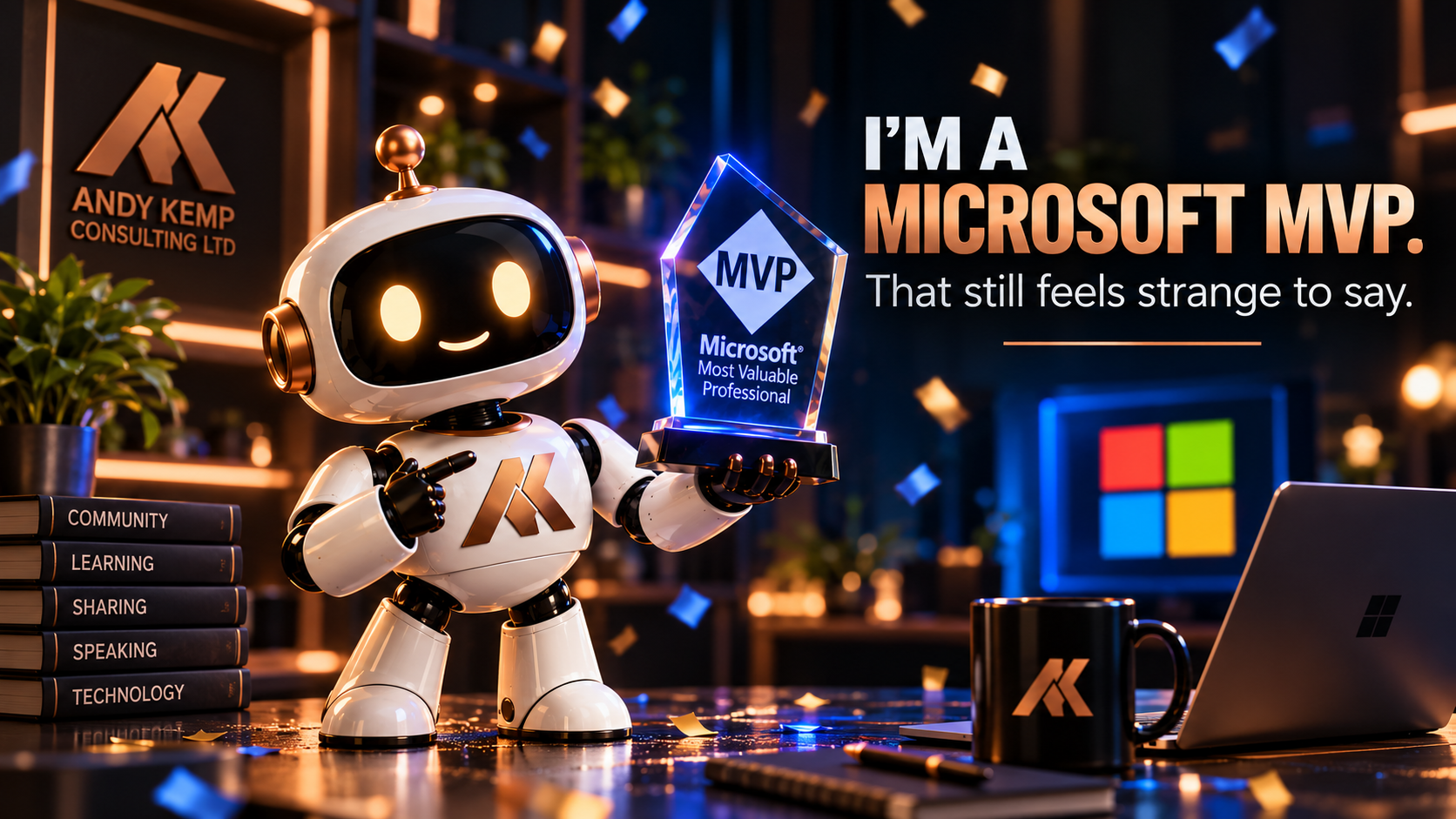
I’m a Microsoft MVP. That Still Feels Strange to Say.
On 1 October, I found out I’d been awarded Microsoft MVP.
Even writing that sentence feels a little strange.
I’ve spent a lot of years working with Microsoft technology. I’ve written about it, spoken about it, argued with it, broken plenty of it in labs and occasionally even got it to do what I wanted.
But I never really did any of that with “become an MVP” as the end goal.
Then, a couple of days before I was due to speak at Scottish Summit at Murrayfield, the message arrived.
I was now a Microsoft MVP.
The timing was pretty special.
I never set out to become an MVP
That probably sounds like one of those things you’re supposed to say after receiving an award.
But it’s true.
I’ve always enjoyed sharing what I learn.
Sometimes that’s writing a detailed technical article because I’ve spent far too long working something out and think somebody else might benefit from not having to do the same.
Sometimes it’s challenging the way we traditionally approach something.
Sometimes it’s speaking at a user group or conference.
Sometimes it’s answering a question or having a conversation with somebody in the community.
And sometimes it’s publishing something only to have somebody point out another way of looking at it, and I end up learning something myself.
That’s the bit I’ve always enjoyed.
The exchange of knowledge.
I certainly haven’t always been consistent with it. There have been periods where I’ve written and spoken a lot, and periods where work and life have taken over and I’ve disappeared from the community side of things almost completely.
But over the last couple of years, I’ve found myself enjoying it again.
Writing more.
Speaking again.
Sharing the things I’m working on.
And perhaps most importantly, having conversations with people who make me question my own thinking.
The MVP wasn’t the objective.
Getting involved again was.
Then James nominated me
There’s one person I need to call out specifically.
James Agombar.
James nominated me for the MVP award.
I knew the nomination had happened, but knowing you’ve been nominated and actually receiving the award are two very different things.
Somebody else looking at the work you’ve been doing and thinking:
“This deserves recognising.”
means quite a lot.
Especially when it’s somebody whose opinion you respect.
So James, thank you.
Not just for submitting the nomination, but for believing there was enough there to nominate in the first place.
Without that nomination, I wouldn’t be writing this post.
Then the timing became slightly ridiculous
The award came through on 1 October.
That same week I was heading to Scottish Summit at Murrayfield.
I was delivering a workshop on the Friday and speaking on Saturday about something I care deeply about:
privileged access.
So after years away from the bigger conference environment, I found myself walking into Scottish Summit having literally just become a Microsoft MVP.
I couldn’t have planned the timing if I’d tried.
There was something quite fitting about it.
The award wasn’t arriving while I was sitting at home thinking about getting involved in the community.
It arrived while I was actively doing it.
Writing.
Sharing.
Speaking.
Meeting people.
Learning from other people.
And standing in a room talking about a subject I genuinely care about.
That made the whole thing feel a little more real.
What actually changes?
This is something I’ve thought about since receiving the news.
And the answer is:
Hopefully, not very much.
Becoming an MVP doesn’t suddenly make me more knowledgeable than I was on 30 September.
It doesn’t make everything I write correct.
It doesn’t mean my architectural opinion is automatically the right one.
And it definitely doesn’t mean I’ve finished learning.
If anything, I’d be slightly concerned if I ever started thinking any of those things.
Technology changes far too quickly for that.
And some of the best conversations I’ve had have started because somebody disagreed with me.
I want that to continue.
If I publish something that’s wrong, tell me.
If you’ve approached a problem differently, tell me why.
If there’s something I’ve completely overlooked, I want to hear about it.
That’s how we all get better.
The letters MVP don’t change that.
But it does mean something
Having said all of that, I don’t want to diminish it either.
I’m incredibly pleased to have received the award.
Microsoft describes the MVP award as recognition for technology experts who passionately share their knowledge with the community.
When I look at some of the people who hold that award, including people I’ve learned from over the years, being included amongst them feels pretty special.
There is probably a little bit of imposter syndrome mixed in there too.
Maybe that’s healthy.
But the way I’m choosing to look at it is this:
Somebody looked at the things I’ve been sharing, the conversations I’ve been having and the contribution I’ve been trying to make and thought it was worth recognising.
That’s something I’m genuinely proud of.
Community is a funny thing
One thing the last few years have reminded me is that community contribution doesn’t have to mean standing on a stage in front of hundreds of people.
It can be a blog post.
A GitHub project.
Answering somebody’s question.
Sharing an architecture diagram.
Helping somebody understand why something isn’t working.
Having a disagreement about how something should be designed.
Or simply introducing yourself to somebody standing on their own at an event.
Some contributions reach thousands of people.
Others might help one.
Both matter.
And that’s something I want to keep reminding myself of.
It’s very easy once awards, follower counts, speaking slots and other visible measures appear to start treating those things as the objective.
I don’t want to do that.
I want the objective to remain:
Share useful things.
If people find them helpful, brilliant.
So what happens now?
Pretty much what I was doing already.
I’ll keep writing.
I may even do a few more conference sessions.
I’ll keep building things.
I’ll keep breaking things in labs.
I’ll keep questioning designs that don’t quite make sense to me.
I’ll keep sharing what I learn from the projects I’m fortunate enough to work on.
And I’ll keep getting things wrong occasionally, hopefully less often as time goes on.
There are plenty of subjects I want to explore further, particularly around identity, authentication, privileged access, Microsoft Entra, Microsoft 365 and the changing way we think about trust in modern environments.
There are also things I’m working on now that I can’t wait to write about once I’ve actually tested them properly.
Because that’s another thing I don’t want the MVP award to change.
I’d much rather say:
“I don’t know yet. Let me test it.”
than pretend I have an answer because there’s now a badge next to my name.
Thank you
To James, again, thank you for nominating me.
To everyone who has read one of my posts, attended a session, asked a question, challenged something I’ve written, shared something I’ve created or simply had a conversation with me:
Thank you.
You probably contributed to this more than you realise.
And to Microsoft and the MVP programme, thank you for the recognition.
I’m looking forward to seeing where it takes me.
But for now, I’m going to keep doing what I was doing anyway:
Learning things.
Breaking things.
Questioning things.
Writing about what I find.
And hopefully helping somebody else along the way.
The badge is lovely.
The opportunity to keep contributing is the bit that matters.
Comments
No comments yet — be the first to leave one below.